

Most app teams treat ASO and user acquisition as two separate jobs. One team handles the store listing. Another team runs the paid campaigns. They rarely talk to each other.
That separation is exactly why so many apps waste budget.
ASO and paid user acquisition are not competitors. They solve different problems, but they work better together than apart. App store optimization vs user acquisition is not a choice you have to make, it is a balance you have to find. Understanding what each one does and when to use it matters. It is the first step toward building a mobile app marketing strategy that actually scales.
What Is ASO?
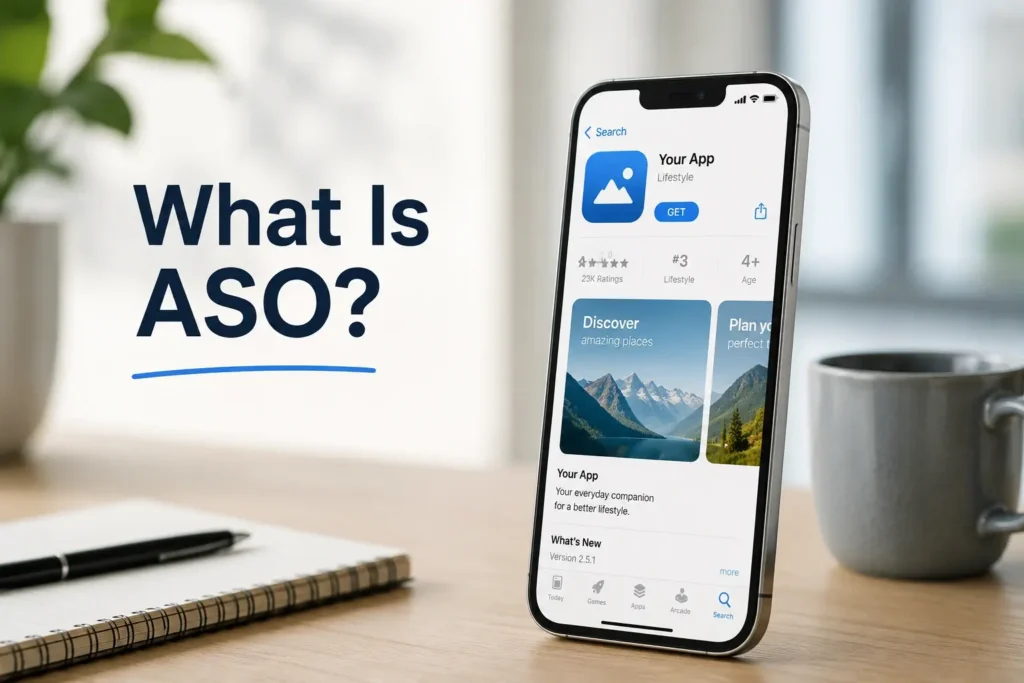
ASO stands for App Store Optimization. It is the process of improving your app’s visibility inside the App Store and Google Play. The goal is to help more users find your app organically, without paying for every install.
Think of ASO as SEO for apps. You optimize your app’s title, subtitle, keyword field, description, screenshots, icon and review ratings. The store algorithm reads these signals to decide where your app ranks in search results.
Around 70% of App Store visitors use search to find new apps and a significant share of downloads happen right after a search. That makes your store listing one of your most important growth assets whether you’re running paid campaigns or not.
ASO focuses on two things: discoverability and conversion. Discoverability means your app shows up when users search relevant keywords. Conversion means users who see your listing choose to download it.
What Is User Acquisition?
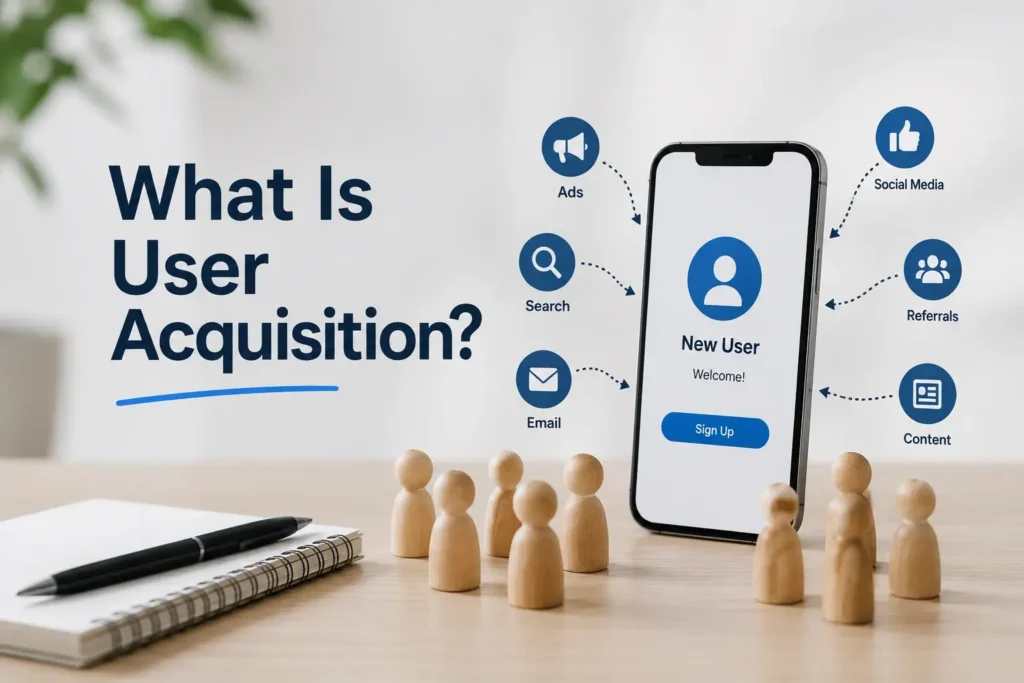
User acquisition (UA) is the process of driving new installs through paid advertising. You run campaigns across ad networks, social media platforms and programmatic channels. You pay for every install, click or action depending on your pricing model.
Paid UA means fast, scalable, measurable growth via ads across in-app networks, programmatic platforms, social media and app store ads.
The core metrics in paid UA are CPI (cost per install), ROAS (return on ad spend) and LTV (lifetime value). Retention rates at day 1, day 7 and day 30 are equally important. These tell you whether the users you’re paying for are actually worth the cost.
Paid UA can scale fast. But it stops the moment you stop spending. That’s the fundamental difference between UA and ASO.
ASO vs User Acquisition: The Core Differences
| ASO | Paid User Acquisition | |
|---|---|---|
| Cost model | Time and effort upfront | Pay per install or action |
| Speed | Slow to build, long-lasting | Fast results, stops when budget stops |
| Scalability | Limited by organic search volume | Scalable with budget |
| Targeting | Keyword and category relevance | Audience, creative and channel targeting |
| Data needed | Keyword research, store analytics | Attribution, CPI, LTV, ROAS |
| Best for | Long-term organic growth | Fast growth and scale |
ASO is a long-term investment. Paid UA is a short-term accelerator. Neither one alone is a complete strategy.
Why You Cannot Rely on ASO Alone
ASO builds organic growth over time. But organic discovery alone is not enough to sustain meaningful growth for most apps. Even apps with strong product-market fit and high retention need paid acquisition to reach scale.
The app stores are crowded. With over 5 million apps on the App Store and Google Play competing for audience attention, relying solely on technology or a good idea is no longer enough.
ASO also takes time. You optimize your metadata, update your screenshots and improve your ratings. The algorithm reacts over weeks, not days. If you need installs now, ASO cannot deliver them fast enough.
Why You Cannot Rely on Paid UA Alone
Paid UA gives you speed. But it comes at a cost that compounds quickly.
The average cost per install across categories has increased 15-25% year over year since 2023. Teams that rely only on paid channels see their unit economics erode over time. When CPIs rise, margins shrink. When the budget pauses, growth stops completely.
Paid UA without a strong store listing also leaks budget. Every paid ad whether on Meta, TikTok or Google sends users to your app store page. If that page does not convert well, you pay for the click and lose the install. You don’t want to spend the majority of your budget on high-quality ads only to lose users at the critical conversion point of the app store listing.
How ASO and Paid UA Work Together
This is the part most app teams miss. ASO and paid UA do not just coexist, they actively boost each other.
Paid campaigns improve organic rankings.
When your paid campaigns drive installs, the app store algorithm notices. Store algorithms track how many users view and install the app, then boost rankings accordingly. More paid installs improve your ranking position, which then brings in more organic installs even after your campaign ends.
A strong ASO lowers your CPI.
Your store page conversion rate directly affects how much you pay per install. Page conversion directly affects CPI: a higher install rate means a lower cost per install from any paid channel. Apple Search Ads also partly factors in metadata quality when determining relevance and bids.
Branded search is the hidden connection.
After someone sees an ad on Facebook or TikTok a significant share of them go to the store and search by brand name or category. If the page is weak at that moment, conversion suffers and part of your paid spend leaks.
These connections mean your ASO work makes every paid campaign more efficient and your paid campaigns accelerate your ASO results.
When to Use ASO vs User Acquisition
Focus on ASO first when:
- You are launching a new app and need a solid store presence before spending on ads
- Your paid CPI is high and you suspect your store page is not converting well
- You are targeting new markets and need localized store listings
- You want to reduce long-term dependence on paid budget
Focus on paid UA when:
- You have a proven store listing with strong conversion rates
- You need to grow fast for a fundraise, a seasonal campaign or a product launch
- You are expanding into new geographies where your organic presence is zero
- You want to test new audiences or creative angles quickly
Do both when:
- You are past early growth and moving toward scale
- You need sustainable growth that does not collapse when the ad budget drops
- You are running Apple Search Ads, since both your metadata and your bids determine your placement
For more on how to track which channels are actually delivering installs, read our guide on Adjust and AppsFlyer attribution setup, accurate measurement is what connects your ASO and UA data into one picture.
How Custom Product Pages Connect ASO and Paid UA
One area where ASO and paid UA now overlap directly is custom product pages.
On iOS, Apple lets you create up to 35 custom product pages with different screenshots, app previews and promotional text. You send specific paid campaigns to specific pages, a gaming ad goes to a page built for gamers, a productivity ad goes to a page built for professionals.
This means creative testing is no longer just a UA discipline. Your ASO team needs to be involved in deciding which store page each audience sees. Teams that split these responsibilities miss the optimization opportunity entirely.
What App Marketers in MENA Get Wrong
In the UAE and broader MENA market, most app teams have a paid UA bias. They scale campaigns before the store listing is ready. They see high CPIs and blame the ad network, when the actual problem is a weak store page that converts poorly.
The other common mistake is treating ASO as a one-time setup. You submit the app, fill in the keywords, upload some screenshots and consider it done. ASO requires ongoing keyword research, creative refresh, A/B testing and localization for each target market.
To get the basics of app store visibility right before spending on ads, check our guide on app marketing tips to drive downloads, it covers the foundational steps that make paid campaigns more efficient.
ASO vs User Acquisition Strategy for Apps in UAE and MENA
ASO and paid user acquisition are not either-or decisions. They are two parts of the same growth system.
Our mobile app user acquisition team in Dubai runs paid UA campaigns alongside ASO strategy for apps scaling in the UAE, KSA and broader MENA region. If you’re spending on paid acquisition without a clear ASO foundation, you’re leaving money on the table. And if you’re only optimizing your store listing without scaling it with paid, we can show you what a combined approach looks like for your category.
Frequently Asked Questions
You can, but it is a risky approach in today’s market. The App Store has over 2.19 million apps and Google Play has over 2 million. Purely organic growth is possible but very slow. What most teams miss is that paid campaigns also temporarily boost organic rankings because increased install volume signals relevance to the algorithm. Skipping paid UA entirely means you are permanently turning off one of your most effective growth levers.
Yes, and this is one of the most overlooked risks in mobile marketing. When you drive traffic from low-quality placements or incentivized networks, the app store algorithm notices the high bounce rate and low engagement. It interprets this as your app being irrelevant to the search query. The result is dropping organic rankings even if your metadata is perfectly optimized. Traffic quality in paid UA directly impacts ASO performance.
Start with ASO but for the right reason. Paid UA only becomes efficient when your store listing page already converts well. If your store page is weak, every paid install wastes money. First, optimize your title, subtitle, screenshots and keyword field. Then run a small paid test and measure your conversion rate. Once your store page converts above 10 to 20 percent, scale paid campaigns confidently.
Yes, both ASO and paid UA are affected by ratings. Apple explicitly includes ratings as a search ranking factor. According to AppTweak’s 2025 benchmarks, 90 percent of featured App Store apps hold a rating of 4.0 or above. On the paid side, a user who clicks your ad and sees a 3.2 star rating on your store page is far less likely to install. This raises your CPI directly. Ratings are a shared performance asset across both channels.
Rankings may dip slightly, but the drop should not be permanent if your ASO foundation is solid. Paid campaigns boost organic rankings temporarily through install volume signals. When you pause, that volume signal decreases. However, if your metadata is strong and your retention rate is healthy, the algorithm does not penalize you permanently. The real problem happens when teams rely entirely on paid spend and ignore ASO then a budget cut leaves them with zero organic presence.
This is one of the biggest shifts in mobile marketing this year. Since July 2025, Apple allows custom product pages to appear in organic search results, previously they only worked in paid campaigns. Apple also increased the limit from 35 to 70 active pages per app in early 2026. This means your ASO team now needs to be involved in creative testing and your UA team needs to think about organic search intent when building campaign pages. The two disciplines are now directly connected through this single feature.