
Dubai gives businesses a unique advantage. The city connects Europe, Asia, Africa and the Americas through world-class infrastructure, a business-friendly environment and one of the most digitally active populations on earth.
However, many Dubai businesses make a critical mistake when they decide to expand internationally. They take the same Google Ads campaigns, the same Meta Ads creatives and the same social media strategy that worked in the UAE and launch them in Saudi Arabia, Egypt or European markets without any adaptation.
The result is almost always disappointing. Budget gets wasted. Leads do not come. The business concludes that international markets do not work for them.
The real problem is not the market. The problem is the approach. Scaling digitally from Dubai into GCC or global markets requires a completely different strategy, built specifically for each target market, tracked properly through tools like Google Search Console and AppsFlyer, and optimized continuously based on real performance data.
Before expanding internationally, make sure your UAE digital marketing foundation is solid. Our guide on how to choose a digital marketing agency in Dubai covers what to get right at home before scaling abroad.
This guide explains exactly how that process works.
Why Does Dubai Give Businesses a Strong Base for Global Digital Expansion?
Dubai sits at a geographic and commercial crossroads that few cities in the world can match. Businesses here already operate in a multicultural environment, manage multilingual communication daily and deal with cross-border transactions as a normal part of business.
Furthermore, the UAE time zone overlaps with business hours in both Europe and Asia simultaneously. This makes managing live campaigns across multiple regions practical in a way that is genuinely difficult from most other business hubs.
Dubai also concentrates an extraordinary density of international business decision-makers. Regional headquarters of thousands of global companies operate here. If your product or service targets enterprises, your potential clients are already within reach before you even expand.
Businesses that are ready to expand internationally often partner with experienced Dubai-based digital marketing experts that understand both local and global growth strategies.
Consequently, a digital marketing agency in Dubai that understands both local market dynamics and international expansion is uniquely positioned to help businesses scale beyond borders without rebuilding from scratch in every new market.
What Are the Biggest Challenges of Scaling Digitally From Dubai?
Scaling digital marketing across borders sounds simple increase the budget, translate the ads and launch in new markets. In reality, however, several specific challenges consistently cause international expansion campaigns to underperform.
Why Does Consumer Behavior Differ Across GCC Markets?
Saudi Arabian consumers behave very differently online compared to UAE consumers even though both markets share Arabic language and cultural similarities. Snapchat carries significantly higher daily active usage among Saudi audiences than in the UAE. TikTok engagement patterns, peak usage times, content sensitivities and purchase decision timelines all differ between markets.
Expanding into European or Southeast Asian markets adds another layer of complexity. Platform ecosystems change completely. In Germany, privacy-conscious consumers respond poorly to aggressive retargeting. In the Philippines, Facebook dominates in ways that Meta Ads in the UAE do not reflect.
A professional agency maps platform usage, content preferences and purchase behavior specific to each target market before a single campaign launches. This prevents the costly assumption that one approach works everywhere.
How Does Search Intent Change Across Languages and Regions?
International SEO is far more complex than translating existing content. When someone in Saudi Arabia searches for a product you sell, they may use entirely different Arabic search terms than a UAE-based Arabic speaker. Google Search Console data from your UAE campaigns tells you nothing about what Saudi users actually type into Google.
Moreover, keyword competition levels differ dramatically across markets. A keyword that costs AED 15 per click in the UAE may cost the equivalent of AED 4 in Egypt or AED 40 in the UK, entirely different return on ad spend calculations apply to each market.
Effective international SEO requires separate keyword research conducted specifically for each target market, hreflang tag implementation to signal language and region targeting to Google and market-specific landing pages that match local search intent precisely.
Why Do Paid Advertising Costs Vary So Much Between Markets?
Google Ads and Meta Ads auction dynamics differ significantly across countries. Cost per click, audience sizes, competition levels and average conversion rates all vary. Without market-specific campaign structures and bid strategies built inside Google Ads and Meta Ads Manager, businesses expanding internationally consistently overspend in some markets and underspend in others.
Furthermore, the platforms that matter most differ by market. LinkedIn Ads drives strong B2B results in European markets but is relatively expensive for Gulf markets. Snapchat Ads delivers exceptional reach in Saudi Arabia at costs that make it one of the most efficient paid channels in the region. TikTok Ads works powerfully for younger demographics across Southeast Asia and increasingly in the GCC.
Building the right paid media mix for each market rather than running identical campaigns everywhere, is what separates profitable international expansion from expensive experimentation.
What Does Real Content Localization Actually Mean?
Translation is not localization. An ad creative that resonates emotionally with UAE audiences can fall completely flat in Saudi Arabia because of different cultural references, visual preferences or messaging tone. Expanding into non-Arabic markets adds another dimension entirely.
Real localization means adapting the core message, creative direction, offer structure and call-to-action copy to fit the cultural context of each target market while maintaining consistent brand identity across all markets. This balance between global consistency and local relevance is what makes international campaigns actually work rather than simply appearing in new markets.
How Does Tracking Become More Complex Across Multiple Markets?
When campaigns run simultaneously across Saudi Arabia, Egypt, the UK, and Southeast Asia, attribution modeling becomes significantly more difficult. Different countries impose different data privacy regulations GDPR in Europe, PDPL in Saudi Arabia that affect how customer data is collected and used.
Mobile measurement platforms like AppsFlyer and Adjust become essential for businesses with app-based products expanding internationally, because they provide accurate cross-market attribution that standard Google Ads and Meta Ads reporting cannot deliver alone. Without this infrastructure in place, you cannot identify which international markets are genuinely profitable and which are consuming budget without returning measurable results.

How Does a Digital Marketing Agency Build an International Expansion Strategy?
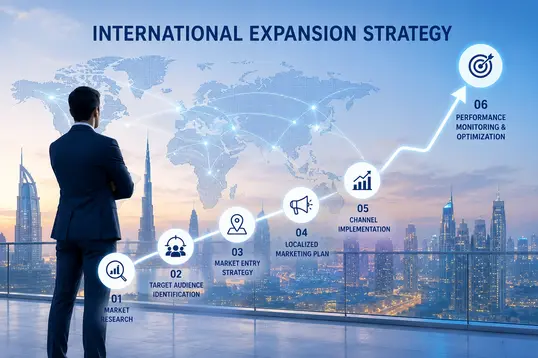
Here is the practical step-by-step process a professional agency follows when helping a Dubai business scale into new markets.
Step 1: Which Markets Offer the Best Expansion Opportunity?
Before any campaigns launch, the agency identifies which markets deserve priority investment. This involves analyzing Google Search Console data to identify whether your website already receives organic traffic from target markets, researching search volume for your key terms in each market, assessing competitive intensity on Google Ads and Meta Ads in those markets and estimating realistic cost per acquisition based on local auction data.
This research phase prevents the common mistake of expanding into markets based on assumption rather than evidence.
Step 2: Build Market-Specific Digital Infrastructure
Once priority markets are identified, the agency builds the digital foundation each market requires. This includes separate landing pages optimized for each market’s specific search intent and local language, hreflang tags implemented correctly across the website to signal language and geographic targeting to Google, conversion tracking configured in Google Search Console and Google Tag Manager for each market separately, and pixel setups in Meta Ads Manager with country-specific audience segmentation.
This infrastructure step is unglamorous but critical. Without it, every subsequent campaign decision is based on incomplete or inaccurate data.
Step 3: Launch Paid Campaigns With Test Budgets First
International paid campaigns whether Google Ads, Meta Ads, TikTok Ads, Snapchat Ads or LinkedIn Ads launch with conservative test budgets in priority markets. The goal of the first 30 to 60 days is not volume. It is data collection.
Real market performance data actual cost per click, conversion rate, cost per lead and cost per acquisition in each market is far more valuable than any pre-launch estimate. This data drives every subsequent budget allocation and optimization decision.
Step 4: Build International SEO in Parallel
While paid campaigns generate immediate traffic, SEO builds the long-term organic visibility that reduces acquisition costs over time. International SEO work runs in parallel with paid campaigns from the start.
For businesses at the start of their SEO journey, our SEO packages in Dubai provide a structured foundation before scaling into international markets.
This includes creating market-specific content targeting the exact search queries users in each country type into Google, building local backlinks from country-specific domains that signal geographic relevance to Google’s algorithm, optimizing page speed and Core Web Vitals for each market since mobile network speeds differ significantly across regions and monitoring Google Search Console for each market separately to identify indexing issues, crawl errors and emerging keyword opportunities specific to each country.
Step 5: Adapt Social Media Strategy for Each Market
Social media marketing strategies must reflect the platform preferences of each target market rather than replicating the UAE approach everywhere.
For Saudi Arabia, Snapchat Ads and TikTok Ads typically outperform Meta Ads for consumer-facing campaigns. For B2B expansion into European markets, LinkedIn Ads targeting decision-makers by job title, company size and industry delivers qualified leads that other platforms cannot match. For Southeast Asian markets, Facebook still dominates in ways that differ significantly from its role in Gulf markets.
Content format preferences also differ. Short-form video dominates in GCC markets. Long-form educational content performs strongly in B2B European markets. Localized creative not simply translated UAE creative consistently outperforms generic international campaigns.
Step 6: Optimize Continuously Based on Cross-Market Data
Once campaigns run across multiple markets and real performance data accumulates, optimization begins in earnest. Budget shifts toward the markets and channels delivering the best return on ad spend. Creative testing continues with market-specific variations. Underperforming markets either receive strategic adjustments or see budget reduced while stronger markets scale.
This continuous optimization cycle run by a performance marketing team with cross-market experience is what transforms initial international expansion from an expensive experiment into a profitable growth engine.
Which Markets Make the Most Sense for Dubai Businesses?
The right expansion markets depend on your industry and product, but here is where Dubai-based businesses most commonly find strong digital growth opportunities.
Saudi Arabia
Saudi Arabia is the most natural first expansion for most UAE businesses. The market is large, digitally sophisticated and currently experiencing rapid ecommerce, fintech and professional services growth. However, Saudi consumer behavior differs from the UAE in ways that require genuine market-specific adaptation not simply extending existing UAE campaigns across the border.
Broader GCC Kuwait, Qatar, Bahrain and Oman
The broader GCC Kuwait, Qatar, Bahrain and Oman represents an accessible cluster of markets with cultural and linguistic similarities to the UAE. A GCC-wide campaign structure with local adaptations often delivers efficient results because the setup investment is spread across multiple markets simultaneously.
Egypt and the wider MENA region
Egypt and the wider MENA region offers large Arabic-speaking audiences at significantly lower Google Ads and Meta Ads costs than Gulf markets. For products suited to mass-market consumers, MENA expansion can deliver high volume at a lower cost per acquisition than Gulf-only campaigns.
UK and European markets
UK and European markets make sense for Dubai businesses in professional services, technology or luxury that have products appealing to international enterprise buyers. LinkedIn Ads and Google Search campaigns targeting English-speaking B2B decision-makers are typically the most cost-effective entry channels for these markets.
What Should You Realistically Expect in the First 90 Days?
International digital expansion does not produce immediate results across every market simultaneously. Here is an honest timeline.
Days 1 to 30 focus entirely on infrastructure market-specific landing pages, campaign setups in Google Ads and Meta Ads, tracking configurations in Google Tag Manager and AppsFlyer or Adjust, and initial creative production. No significant traffic or leads arrive in this phase.
Days 30 to 60 see initial campaigns launch in priority markets with test budgets. Real performance data starts accumulating. The agency identifies which markets respond, which creative approaches generate clicks and conversions and what initial cost per acquisition looks like in each market.
Days 60 to 90 bring optimization based on real data. Budget shifts toward the markets and campaigns performing best. International SEO work begins showing early indexation in Google Search Console for target markets.
Month four onwards produces a clear picture of which markets offer profitable acquisition at scale. This is the point where confident budget scaling in proven markets delivers compounding growth.
Is International Digital Expansion Right for Your Business Right Now?
International expansion through digital marketing works best when a few conditions are already in place. Your UAE campaigns should already be performing profitably international expansion amplifies what works, it does not fix what is broken domestically. Your website should be technically healthy with clean crawlability, fast load speeds and proper conversion tracking already functioning. And you need realistic expectations about timelines the first 60 to 90 days are an investment in data, not immediate revenue.
If those conditions exist, expanding digitally from Dubai into GCC and global markets is one of the highest-leverage growth moves available to your business.
Contact Medialinks to discuss which markets make the most sense for your specific situation and what a realistic international digital marketing strategy looks like for your goals.
Frequently Asked Questions
A professional agency builds Saudi-specific campaigns that account for local platform preferences particularly Snapchat Ads and TikTok Ads, Arabic dialect differences in search terms, Saudi-specific advertising regulations and different consumer behavior patterns compared to the UAE. Simply extending UAE Google Ads and Meta Ads campaigns into Saudi Arabia without this adaptation consistently underperforms.
International SEO helps your website appear in Google search results in target countries by using hreflang tags to signal language and geographic targeting, creating market-specific content that matches local search intent and building backlinks from country-specific domains. Without international SEO, your website remains invisible in organic search results in new markets regardless of how strong your UAE rankings are.
AppsFlyer and Adjust are mobile measurement platforms that track app installs, in-app events and conversions across multiple countries and advertising channels simultaneously. They provide accurate cross-market attribution that shows exactly which campaigns, channels and creatives drive results in each country making budget allocation decisions across international markets data-driven rather than guesswork.
The most common and most expensive mistake is launching the same Google Ads campaigns, Meta Ads creatives and social media content in new markets without any adaptation. Consumer behavior, platform preferences, search intent and content expectations differ significantly between the UAE, Saudi Arabia, European and Southeast Asian markets. What works in Dubai requires genuine localization to work elsewhere.
A practical starting point for testing one or two priority markets is AED 15,000 to AED 35,000 per month in combined agency management fees and media spend across Google Ads, Meta Ads and local platforms. This test budget generates enough real performance data within 60 to 90 days to make confident scaling decisions in the markets that prove profitable.